

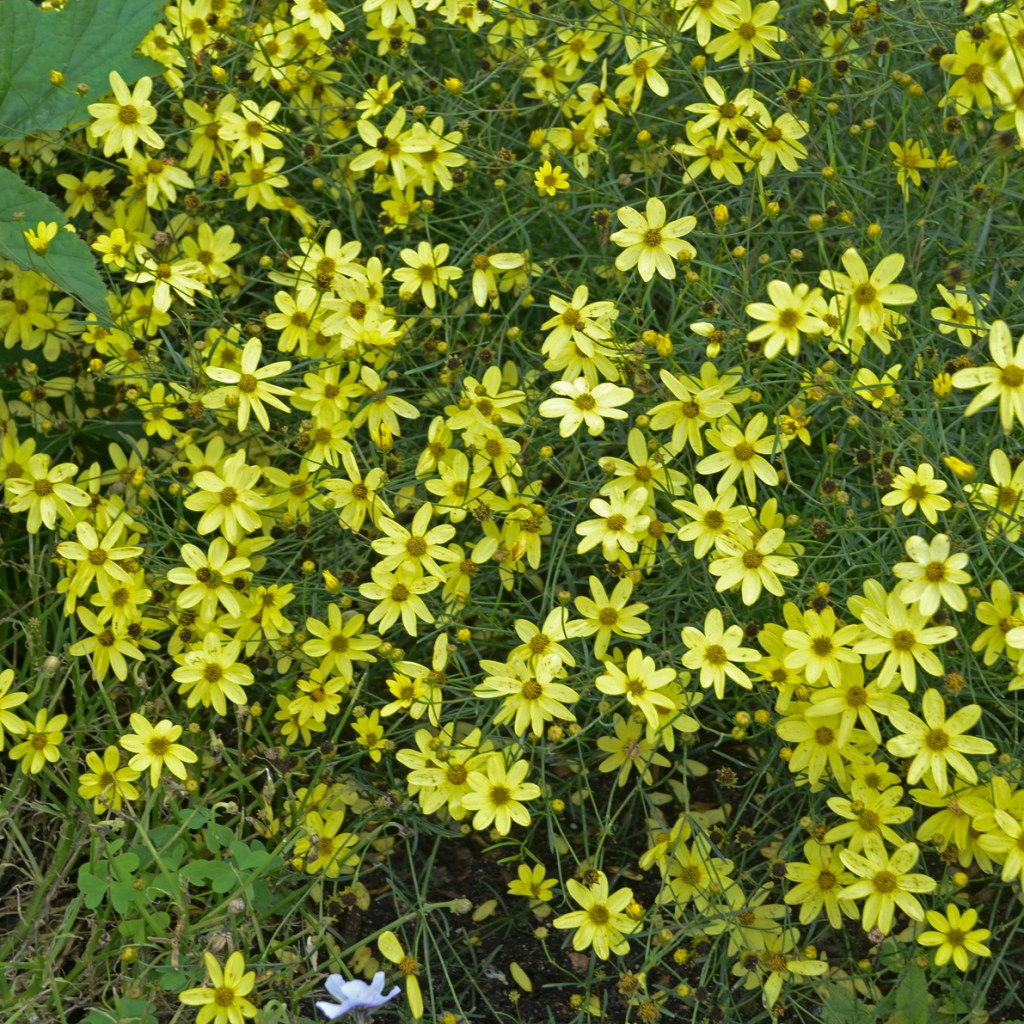
Photos thanks to Walters Gardens, Inc.
1992 Perennial Plant of the Year®
The Perennial Plant Association’s Plant of The Year® for 1992 is Coreopsis ‘Moonbeam’. Though the plant is often listed as a cultivar of Coreopsis verticillata, some authorities feel that it may be of hybrid origin. The fact that this cultivar appears to be sterile may lend credence to the theory of it originating as an interspecific cross. We are not sure when the plant was first named or by whom, nor do we know if it originated from a man-made cross/selection or as a naturally occurring hybrid/selection.
Despite its somewhat uncertain background, this cultivar stands as one of our most easily grown and longest blooming perennials. The foliage of ‘Moonbeam’ is divided into thread-like segments and the combination of its narrow leaves and wiry stems imparts a very fine texture to the clumps. Evolution of this type of foliage habit allows the plant to survive well in heat and drought because there is very little leaf surface area from which water can be lost. In bloom, this perennial stands 18 to 24 inches tall. The creamy yellow, daisylike flowers, though only 1 to 2 inches across, are borne in such profusion as to cover the plant and create quite a show in the landscape. This plant will flower throughout the summer and even into the fall months in some areas. It is nearly impossible to say how many weeks of bloom one can expect from ‘Moonbeam’ as more southerly areas will get a longer show than northern locations with shorter growing seasons.
Coreopsis ‘Moonbeam’ is a reliable performer in hardiness zones 4 through 8. Gardeners in zone 3 may do well with the plant if it receives a dependable snow cover each winter or is mulched with marsh hay, straw or some other non-packing material. Well-drained soils are key to longevity with this perennial, so heavy clays need to be amended with generous amounts of organic matter. Performance will be ideal on medium to coarse textured soils. Soil pH does not appear to be a limiting factor as long as it does not approach the extremes of acidity or alkalinity. Fertility needs are not high, consequently the plant does not require ambitious feeding programs to insure good performance. For the maximum amount of bloom and the most attractive growth habit, ‘Moonbeam’ should be planted in full sun. In areas with extremely long, hot, humid summers, planting this perennial in very light shade will also give good results. There do not appear to be any insect or disease problems that regularly afflict ‘Moonbeam’.
Division of the crowns, though not regularly required, is easily accomplished in fall or early spring just as the plant commences growth. Gardeners in northern areas would be advised to opt for spring division in order to minimize the potential for winter damage to the plants. ‘Moonbeam’ is somewhat like balloon flower in that it is slow to appear in spring.
‘Moonbeam’ has a variety of uses in the home landscape but is perhaps most highly valued as a border plant. Its fine texture contrasts effectively with the bold foliages of many other perennial and woody plants. Consider combining ‘Moonbeam’ with some of the following perennials: Echinacea purpurea, Eryngium yuccifolium, Geranium x oxonianum ‘Claridge Druce’, Helictotrichon sempervirens, Hemerocallis, Monarda didyma, Platycodon grandiflorus, Stachys byzantina and Veronica ‘Icicle’. Do not overlook the potential of ‘Moonbeam’ as a container plant, including use in hanging baskets.
Photos thanks to
PLANT DATA
Hardiness
USDA Zones 4 to 8
Light
Full sun to very light shade
Size
18-24 inches tall
Soil
Well-drained soil is key to successful culture
 Perennial Plant of the Year®