

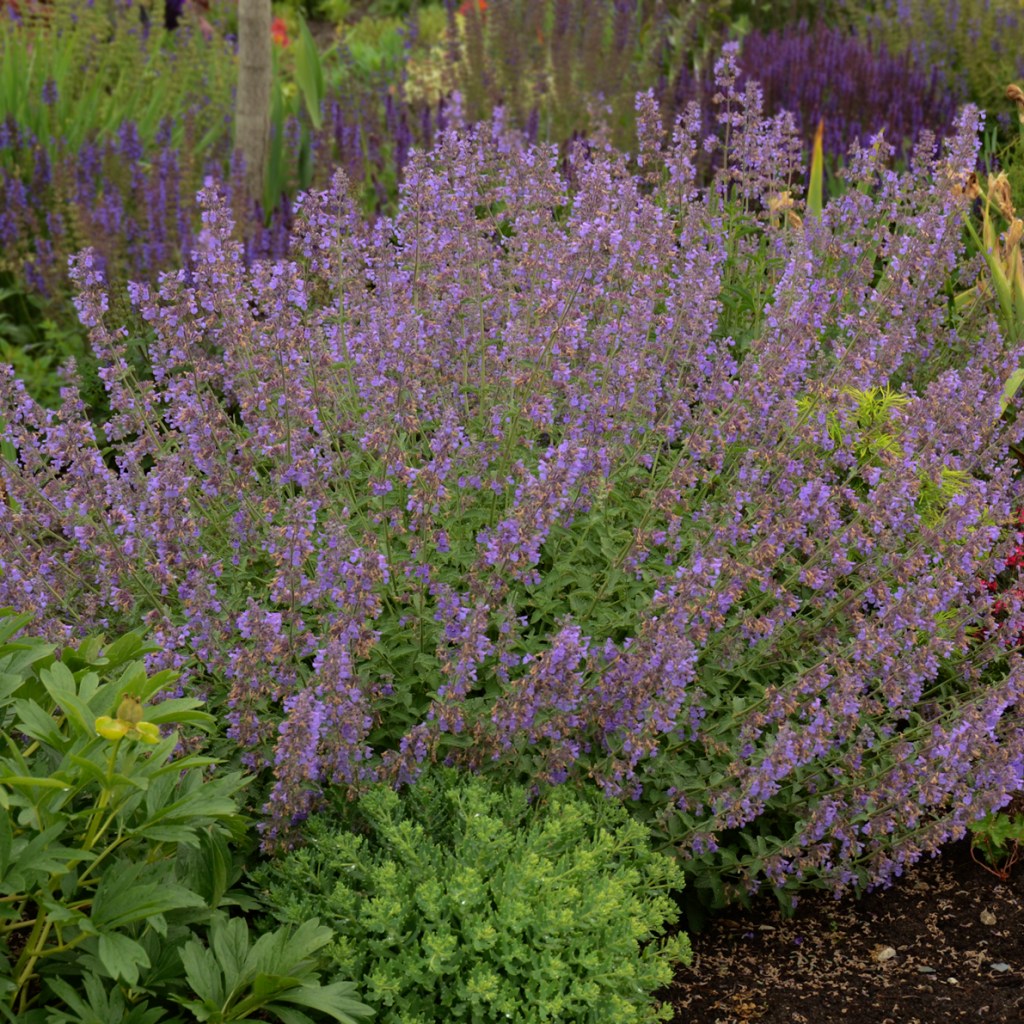
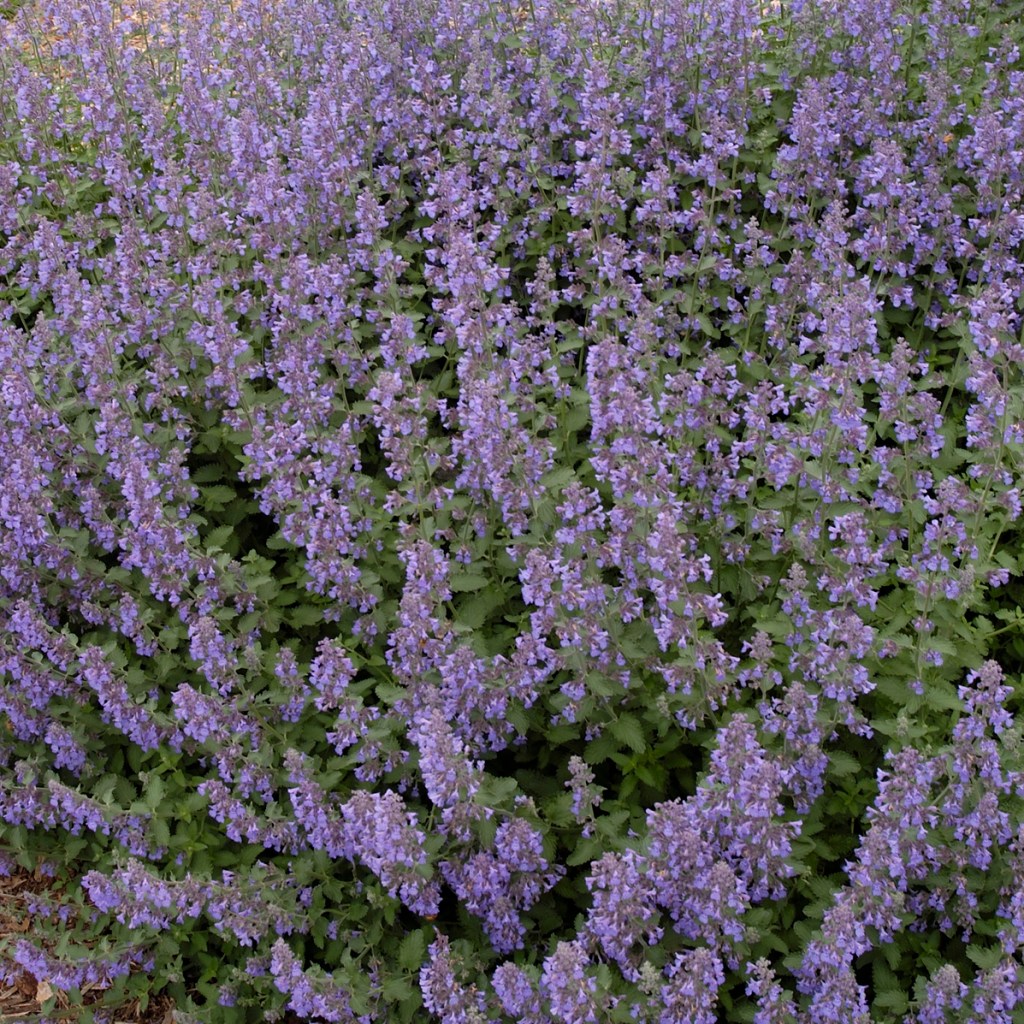
Photos thanks to Walters Gardens, Inc.
2007 Perennial Plant of the Year®
The Perennial Plant Association awarded the title of Perennial Plant of the Year® 2007 to Nepeta ‘Walker’s Low.’ Introduced in 1988 in Europe, Walker’s Low catmint has become increasingly popular with each passing year due to its lovely blue-violet flowers and their long bloom time, attractive grey foliage, ease of propagation, lack of pest or disease problems, and low maintenance requirements.
Nepeta ‘Walker’s Low’ is a member of the Lamiaceae, or mint family. The family is one of the most easily recognized with species having square stems and opposite leaves that are often aromatic. Walker’s Low catmint is a selection in the Faassenii Group of Nepeta, that is, those catmints related to Nepeta x faassenii, thought to be a hybrid between N. nepetella x N. racemosa. First cited in the literature in 1784, Faaseen’s catmint has proven to be a stalwart garden performer.
Mrs. Patricia Taylor selected Walker’s Low in an Irish garden in the 1970s. Thus, its name reflects its origins, rather than (as many gardeners assume) it’s growth habit. Actually, its height can be up to 36 inches tall, which makes it one of the largest cultivated nepetas. In 1988, Four Seasons Nursery of Norwich, England introduced it to the gardening public.
Walker’s Low catmint has crinkled, aromatic, silver-green foliage. Prolific, small, dark blue-purple flowers are clustered densely on upright arching stems creating a charming and colorful effect, even from a distance. It will bloom almost continuously throughout the season, from May until frost, if it is pruned back by two-thirds when the initial flowers fade. Walker’s Low is 36 inches tall with a spread of 30 to 36 inches.
In the landscape, Walker’s Low catmint has many uses, based on its lovely color and vigorous, billowy habit. It is a good companion plant for both early summer and late season combinations, pairing well with previous Perennial Plants of the Year, like Coreopsis verticilata ‘Moonbeam’, Salvia nemorosa ‘Mainacht’ (May Night), or Dianthus gratianopolitanus ‘Feuerhexe’ (Firewitch). Interesting combinations may be made with colorful purple-leaved sedums like ‘Vera Jameson’ or “Black Jack’ and short grasses, for example Pennisetum alopecuroides ‘Hameln’ or Festuca glauca ‘Elijah Blue’.
Often cultivated in the herb garden, Nepeta ‘Walker’s Low’ combines well with sages, thymes, and silvery plants like lamb’s ears (Stachys byzantina). Catmint is a classic companion for roses – its soft, mounded habit camouflaging effectively the often unattractive lower stems of roses. For a scene straight out of grandmother’s garden pair it with foxgloves, peonies, pinks, and bearded iris.
In the wildlife garden, catmint constantly will be visited by an array of bees and butterflies. However, it is resistant to deer and rabbit foraging. As with all catmints, this plant contains the chemical nepetalactone, which is attractive to cats. Some anecdotal evidence supports the claim that “Walker’s Low” does not inspire extensive feline activity.
Use Walker’s Low catmint as a border plant to outline a walkway, in the rock garden to cascade over rocks, or as a ground cover in a sunny location. It is a colorful partner in a container. Try pairing it with salmon-yellow Alstromeria “Princess Victoria” and dark blue salvia to accent a corner of the deck or patio.
Hardy in zones 3 to 8, Walker’s Low catmint thrives in average, well-drained garden soil, preferably with a neutral pH. Once established, it is drought-tolerant, and along with the other catmints, salt-tolerant. This catmint should be cultivated in a sunny site, but will tolerate some shade in hot climates. Flowering will continue through the summer if pruned back by two-thirds when the initial flowers fade. Nepeta ‘Walker’s Low’ has few pest or disease problems.
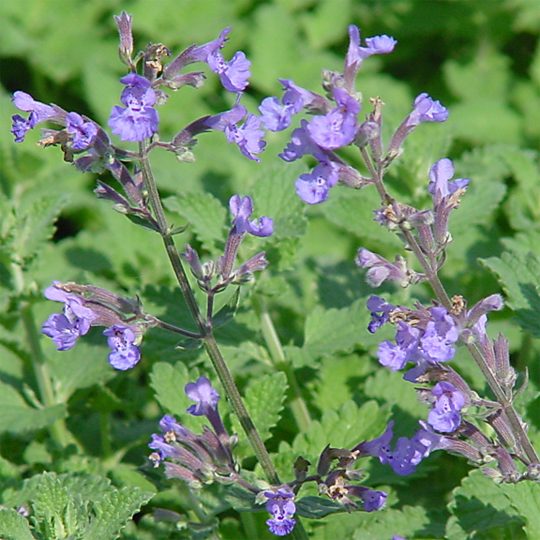

Photos thanks to Midwest Groundcovers.
PLANT DATA
Hardiness
USDA Zones 3 to 8
Light
Best in full sun, but can tolerate shade in hot climates.
Size
36 inches tall; 30-36 inches wide
Soil
Prefers well drained soil and neutral pH
 Perennial Plant of the Year®