


Photos thanks to Walters Gardens.
1995 Perennial Plant of the Year®
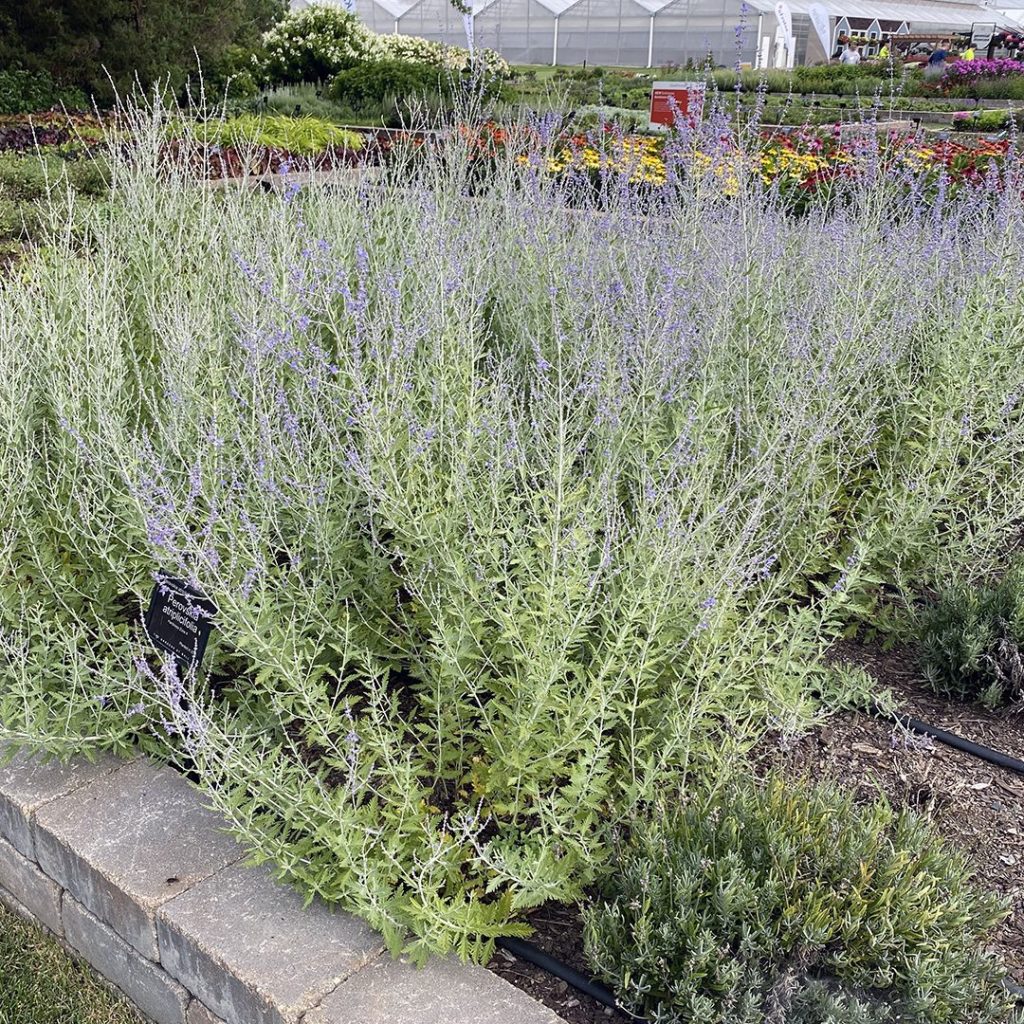
The Perennial Plant Association announced that Perovskia was selected as the Perennial Plant of the Year® for 1995. Commonly called Russian sage, Perovskia has silver stems and small, grayish foliage. It reaches heights of nearly 4 feet and it is categorized as a sub-shrub with a woody base. The leaves are barely toothed, 1.5 inches long and, when crushed, have the scent of sage. Small, light blue to lavender flowers are arranged in whorls along the stem and the spikes are often 12″ long or more. Perovskia begins flowering in July and often lasts throughout September. In winter, Russian sage provides interest in the garden with its silver-gray foliage and stems.
Although there are seven species of Perovskia, only a few are cultivated and available. Perovskia atriplicifolia, the most readily available, is native to Afghanistan and Tibet and is a member of the mint family. However, the Perovskia atriplicifolia currently sold in the US has been identified as a hybrid between P. atriplicifolia and P. abrotanoides, and appears to be Perovskia identical with P. ‘Blue Spire’.
Perovskia atriplicifolia grows best in sunny, dry locations and is one of the most heat and drought resistant perennials available. It is easily grown in hardiness zones 3 through 8, but it will perform best in areas with consistently warm summers, even when the humidity is high. In shaded areas, plants will grow, but tend to be leggy and sprawling. The only condition that Perovskia resents is poor drainage, especially in winter. For best results, plants should be cut back nearly to the ground each spring before new growth begins.
Perovskia is normally purchased as a potted plant. At planting, loosen the soil in an area 2-3 times the diameter of the pot. Thoroughly work in a complete fertilizer like a 10-6-4 or a 10-10-10 at the rate of 2-3 lbs/l00 square ft, into the top of 6-8 inches of soil in the planting area. In addition, 4-6″ of leaf mold or other organic compost can be spread over the planting area and thoroughly worked into the soil to a depth of 6-8″. Composts are particularly valuable in improving soil structure and water holding capacity. Finally, remove the plant from the pot and set it at the same depth as in the pot. Firm the soil around the plant and water in thoroughly.
Commonly available Perovskia cultivars are: ‘Blue Mist’, ‘Blue Haze,’ ‘Blue Spire’, and ‘Longin’. The earliest flowering cultivar is ‘Blue Mist’ which, along with ‘Blue Haze’, has lighter blue flowers than the species. ‘Blue Spire’ has deep purple flowers and larger panicles. ‘Longin’ has stiff upright stems and a more formal appearance than the species. A new cultivar, Filigran, which will be available for 1994, has deeply cut foliage, bright blue flowers, and is more compact than other cultivars.
In the landscape, Perovskia’ s bright blue flowers are particularly striking when planted along with white flowered species like Phlox paniculata ‘Mt. Fuji’. And, besides its attributes as a landscape plant, Perovskia is also a reasonably good cut flower. Other landscape uses include massing or filler in the border as well as being used to separate dominant colors.

Photos thanks to Midwest Groundcovers.
PLANT DATA
Hardiness
USDA Zones 3 to 8
Light
Full sun preferred
Size
Nearly 48 inches tall
Soil
Well-drained garden soil
 Perennial Plant of the Year®