

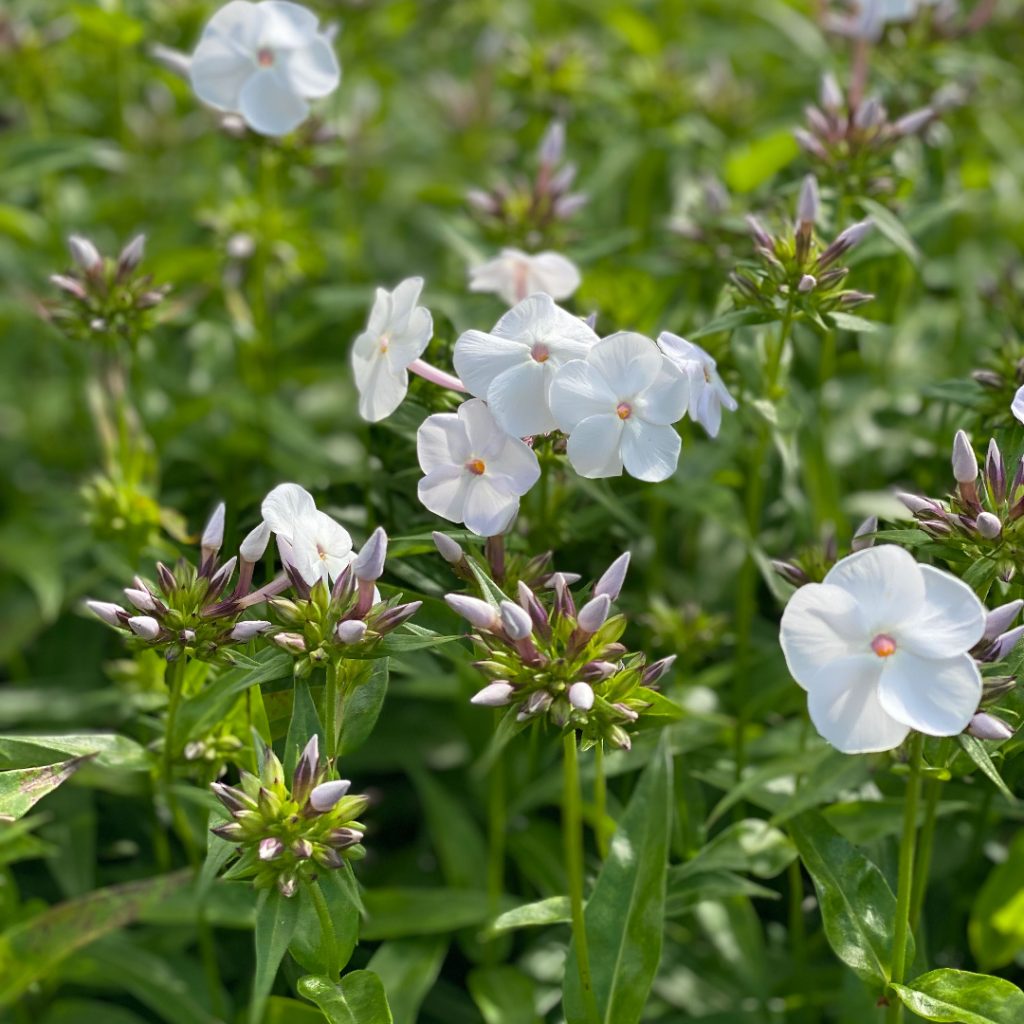
Photos thanks to Midwest Groundcovers.
2002 Perennial Plant of the Year®
The Perennial Plant Association awarded the title of Perennial Plant of the Year® 2002 to Phlox ‘David’. Contemporary nomenclature now lists Phlox ‘David’ as Phlox ‘David’ Paniculata Group rather than the long standing name Phlox paniculata ‘David’. Phlox is a member of the Polemoniaceae family and is native from New York to Georgia and west to Arkansas and Illinois. The great naturalist and plant explorer John Bartram sent Phlox paniculata to England in the early 1700s. ‘David’ is an erect perennial 36-40 inches tall with opposite leaves. The glossy leaves are thin with bristly hairs on the margins. The fragrant whjte flower panicles are 6 to 9 inches long and 6 to 8 inches wide with I inch diameter florets. Phlox ‘David’ has a long bloom period during the summer. It performs well in hardiness zones 4 to 9.
Phlox ‘David’ is an offspring of native Phlox paniculata plants rescued and preserved in the 1980s by volunteers at the Brandywine Conservancy, near Philadelphia. These volunteers acting under the able leadership of F.M. Mooberry, established Phlox paniculata plants in a bed at the Brandywine River Museum, Chadds Ford, Pennsylvania (part of the Brandywine Conservancy). These phlox were grown from open pollinated seed collected in the Brandywine Valley’s natural areas. They may well be the descendants of the phlox that John Bartram sent to England in the 1730s. On an August day in 1987, Richard Simon of Bluemount Nurseries, Monkton, Maryland and FM. Mooberry (Horticultural Coordinator for The Brandywine Conservancy) inspected the Phlox paniculata collection. During this visit Mr. Simon suggested that a white fragrant form should be introduced because of its clean foliage with little trace of powdery mildew. Mrs. Mooberry selected the name of David, after her husband David Mooberry.
Initial propagation was undertaken by Bluemount and North Creek Nurseries, Landenberg, Pennsylvania, followed by propagation at Dunvegan Nursery, Coatesville, Pennsylvania and Greenleaf Enterprises, Lancaster, Pennsylvania. Subsequently, plants were disseminated throughout the perennial industry. Research at the University of Vermont and Cornell University determined that Phlox ‘David’ was superior in powdery mildew resistance and it was cold hardy to zone 4.
Phlox paniculata is known as garden phlox, summer phlox, perennial phlox, or autumn phlox. It is a delight to all gardeners because it has a long bloom season. Many landscape designers call it “the backbone of the summer border.” ‘David’ can be used in both the formal garden and the informal garden as in a cottage garden style or in a naturalized design. It provides great garden color and fragrance from July through September. Use ‘David’ with Echinacea purpurea ‘Magnus’ (purple cone flower) or Echinops ritro (globe thjstle) for a study in color and textural contrasts. For a stunning effect plant ‘David’ with Miscanthus sinensis ‘Morning Light’ or Miscanthus sinensis ‘Cabaret’ to provide a color echo of the variegation of the grass foliage with the white flowers of ‘David’. The blue flowers of Aster laevis ‘Bluebird’ highlight the white panicles of Phlox ‘David’ for an excellent autumn blooming combination. If gardeners are looking for a great choice for fragrance, color, mildew resistance, and long season bloom, there is no better choice than Phlox ‘David’.
An excellent cultivar of an old-fashioned favorite, this long-blooming perennial for full sun to partial shade grows best in moist but well-drained soil. If planted in full sun, organic matter and extra water should be added to mitigate the effects of heat and drought. Without these precautions, spider mites may be a problem. Old blossoms should be removed from the plant to maintain vigor, prolong bloom, and prevent self-seeding. Deadheaded plants will flourish into early fall. Plants should be divided every two to three years to maintain vigor.
Although Phlox ‘David’ is fairly resistant to powdery mildew, proper culture will aid in mildew prevention. Plants should be thinned to four to six stems to increase air circulation and to prevent a heavy mass of stems. Phlox should be watered at the base of the plant and not the foliage.
Photos thanks to
PLANT DATA
Hardiness
USDA Zones 4 to 9
Light
Full sun to partial shade
Size
36-40 inches tall
Soil
Growth is optimal in moist, but well-drained, soils
 Perennial Plant of the Year®